
Inga Edulis Growing Guide for Mediterranean Climates
Quick Tree Profile
Scientific Name: Inga edulis
Family: Fabaceae (legume family)
Common names: Ice-cream bean, guaba, pacay
Type: Fast-growing legume fruit tree
Origin: Central & South America (Amazon basin)
Current distribution: Widely grown across the tropics and subtropics
Adult size: Up to 30m in the tropics; 6–15m in Mediterranean climates (easily kept smaller with pruning)
Growth speed: Very fast — a 40cm seedling can reach 3m in about 2 years under good conditions (botanical garden observation)
First fruiting: Usually the 3rd year after planting (botanical garden observation)
Pollination: Benefits from cross-pollination; plant more than one tree when possible
Nitrogen fixation: Yes — this tree improves the soil it grows in
Main uses: Fresh fruit, shade, soil improvement, agroforestry, firewood
We’ll be covering quite a few different aspects about growing healthy and productive Inga edulis plants in our Southern European climate. Feel free to find the content you’re looking for in the index below:
JUMP TO —> Why Grow Inga edulis? — Climate Requirements — Sun & Site Selection — Soil Requirements — Water Needs — Planting Guide — Pruning & Size Control — Flowering, Fruiting & Harvesting — Pests & Diseases — Propagation — Ecological & Educational Value — Is Inga Edulis Right for You? — Scientific References & Further Reading
Why Grow Inga edulis?
Inga edulis is grown for shade, soil health, and one of the most unusual fruits in the world.
In Mediterranean climates it stands out for:
Very fast growth — one of the fastest trees you can plant
Edible fruit with a unique vanilla ice-cream flavour
Nitrogen fixation — it feeds the soil around it
Very attractive to pollinators and beneficial insects
Originally native to the Amazon basin, Inga edulis has been cultivated by Indigenous communities since pre-Columbian times. It is one of the most important agroforestry trees in Latin America, traditionally used to shade coffee and cacao plantations while improving the soil through nitrogen fixation.
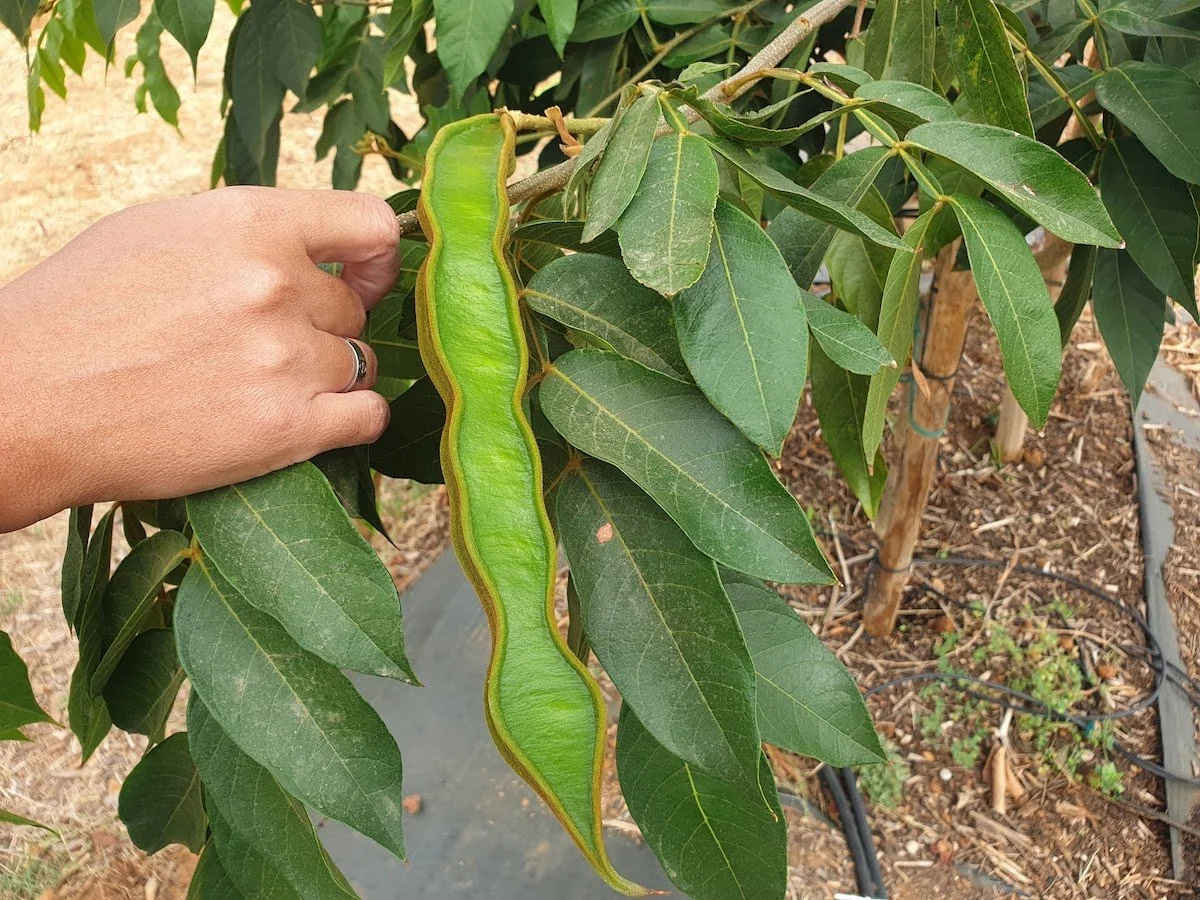
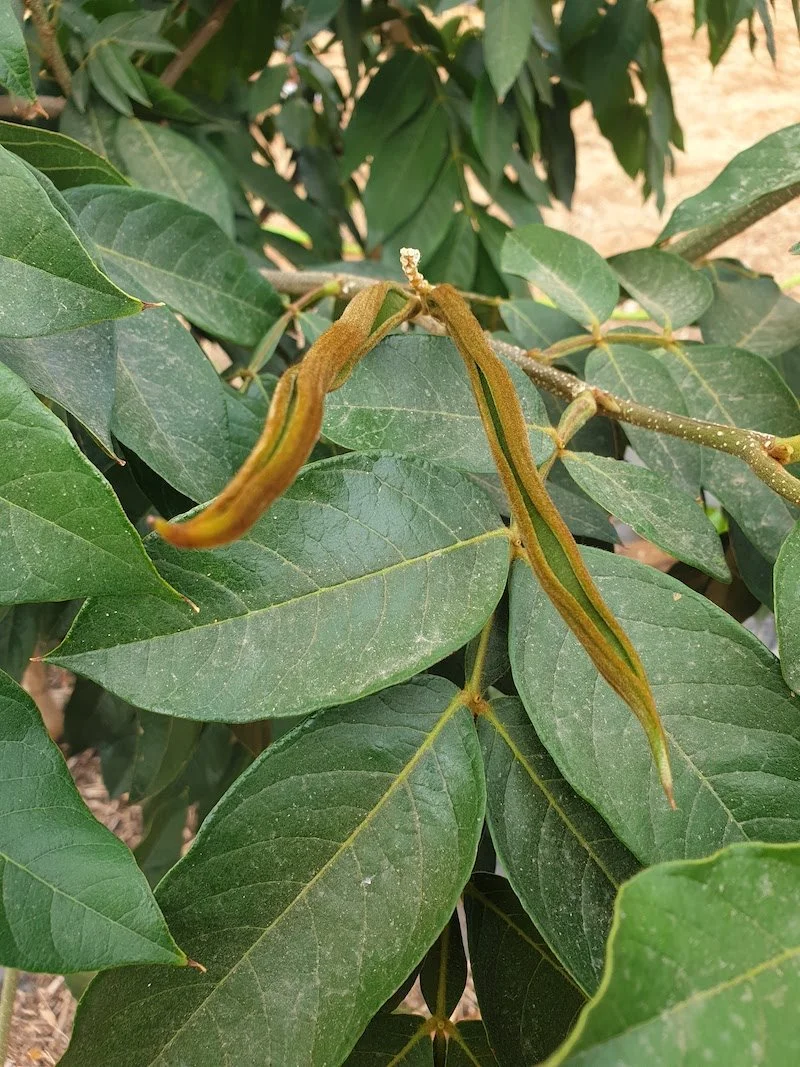
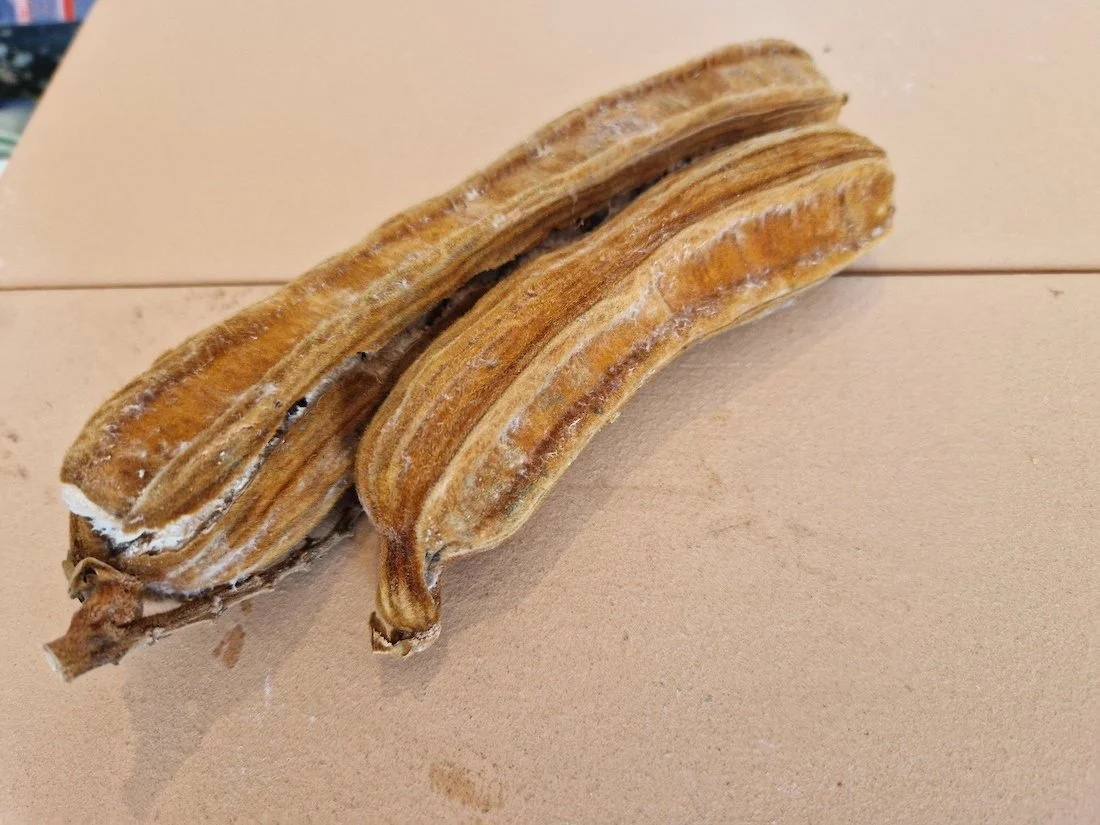
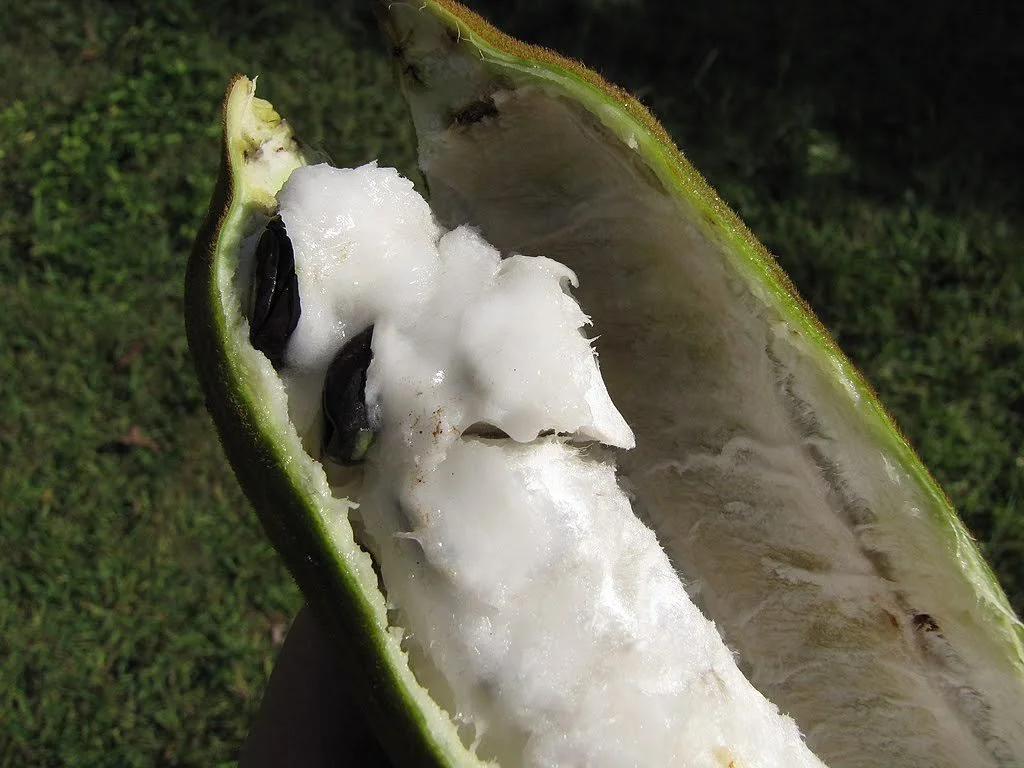
The fruit is a long pod — sometimes up to one metre — filled with a sweet, white, cottony pulp that surrounds the seeds. The pulp is eaten fresh, straight from the pod. Its flavour is often described as vanilla ice cream with a hint of cinnamon, and its texture is like cotton candy. Children love it. The common name "ice-cream bean" comes directly from this experience.
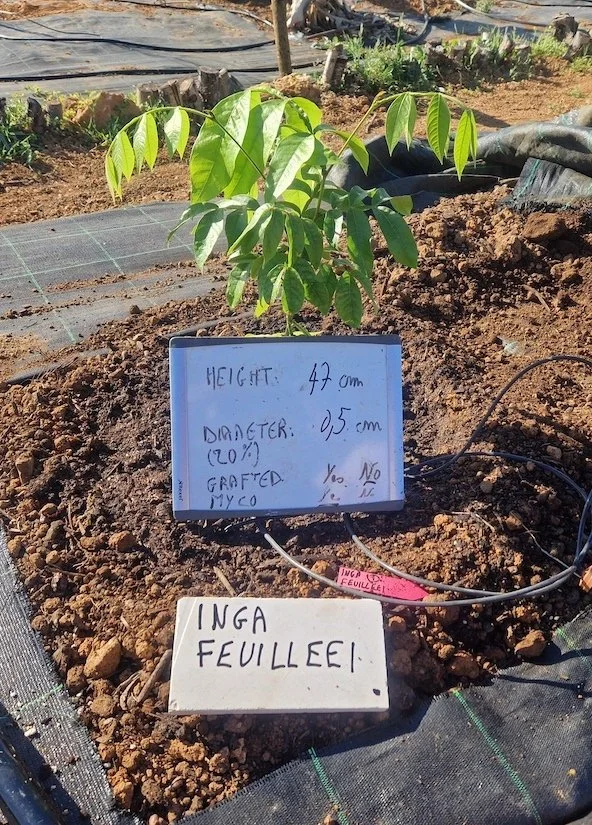
Other Inga species worth exploring: The genus Inga contains roughly 300 species. The botanical garden is currently experimenting with several beyond Inga edulis, including Inga feuilleei, Inga vera, Inga spectabilis, Inga vulpina, and Inga sp. pequena (a small-fruited form still to be identified). Each species has different pod shapes, sizes, and flavour profiles, and their behaviour in Mediterranean climates is still being assessed.
📚 For a complete botanical overview of the Inga genus and its distribution, see Pennington (1997).
Climate Requirements
Temperature
Best growth: 23–30 °C
Active growth: 18–35 °C
Young trees are frost-sensitive and can be killed at 0 °C
Mature trees can survive very brief frosts down to around −2 °C, but with damage
Mediterranean Context
Best suited to warm coastal Mediterranean areas with mild winters
Performs best where winter temperatures stay above 2–3 °C
Inland frost pockets are risky, especially for young trees
Sun & Site Selection
Full sun is essential for good growth and fruiting
Light shade tolerated when young, but the tree needs full light to flower and fruit
Protection from strong, cold winds is important
Best sites: south or south-west exposure, near walls or buildings that store heat. Avoid exposed hilltops and cold air pockets. In Mediterranean climates, a sheltered position makes a real difference for winter survival.
📚 Research on the growth performance and survival of Inga edulis in various agroforestry systems [Lojka et al., 2010].
Soil Requirements
Soil Type & pH
Inga edulis is very adaptable to different soils, growing well in sandy, loamy, and even heavy clay types. It is especially well known for its tolerance of poor, acidic soils, often outperforming other trees in low-fertility conditions.
The best pH range is slightly acidic to neutral (5.0–6.5), but the tree also tolerates strongly acidic soils (down to pH 4.5) and moderately alkaline soils (up to pH 8.0). In most Mediterranean gardens, the soil will be fine without special amendments.
Botanical garden observation:“The botanical garden is also experimenting with Inga in soil with a pH of 8.5, and the trees are growing moderately well (less fast, less fruit, but still showing deep, dark green leaves).”
Drainage
Unlike many tropical fruit trees, Inga edulis can tolerate temporarily waterlogged soils.
Botanical garden observation: “We planted an Inga 2 meters away from a pond. The tree is clearly waterlogged during the winter months and we see strong continuous growth.”
📚 Fact sheet on Inga edulis performance in various soil types [Lawrence, 1993].
Water Needs
Establishment
Regular watering is essential during the first two to three years. In Mediterranean climates with dry summers, consistent irrigation during the warm months is critical for establishment and good growth.
Mature Trees
Inga edulis has a wide native range — from year-round wet Amazonian lowlands to seasonally dry areas with up to six months of drought. Once established, the tree is surprisingly drought tolerant. However, in Mediterranean climates, summer irrigation will significantly improve growth, leaf retention, and fruit production. A thick organic mulch is strongly recommended.
Planting Guide
Best Planting Time
Plant when night temperatures stay reliably above 15 °C and frost risk is over. In Mediterranean climates, this means late May to September. The best months are May, June, or July, to give the tree a full warm season to establish before its first winter.
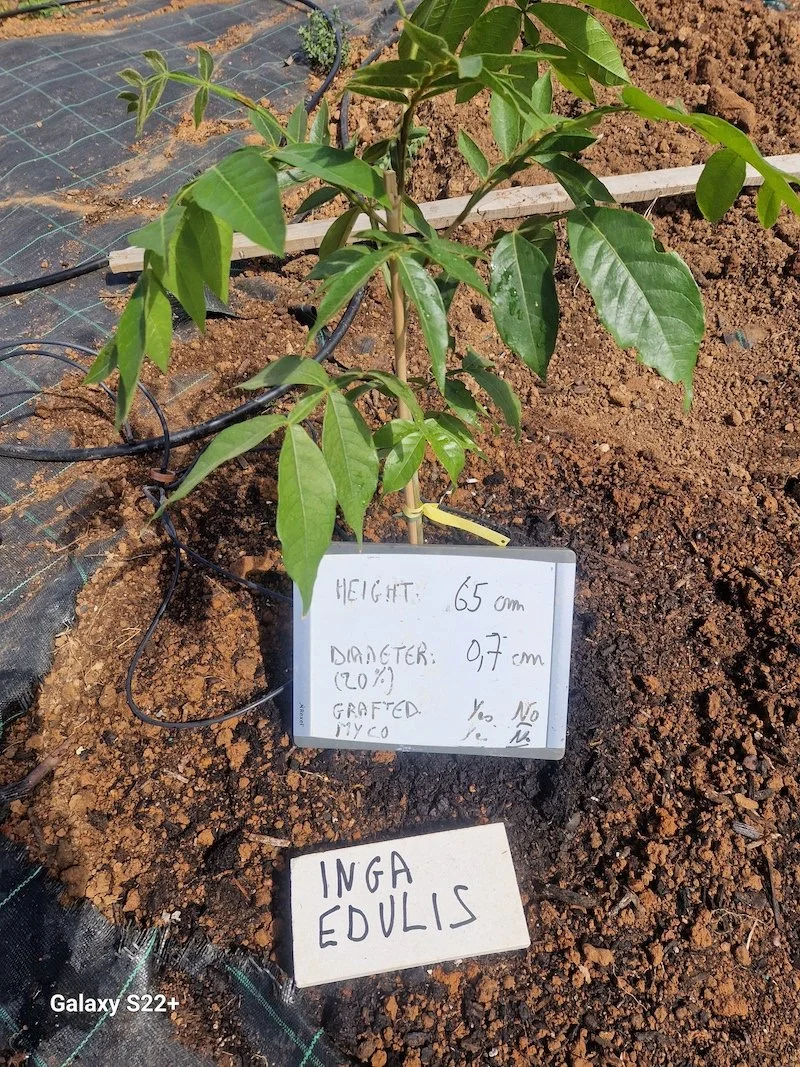
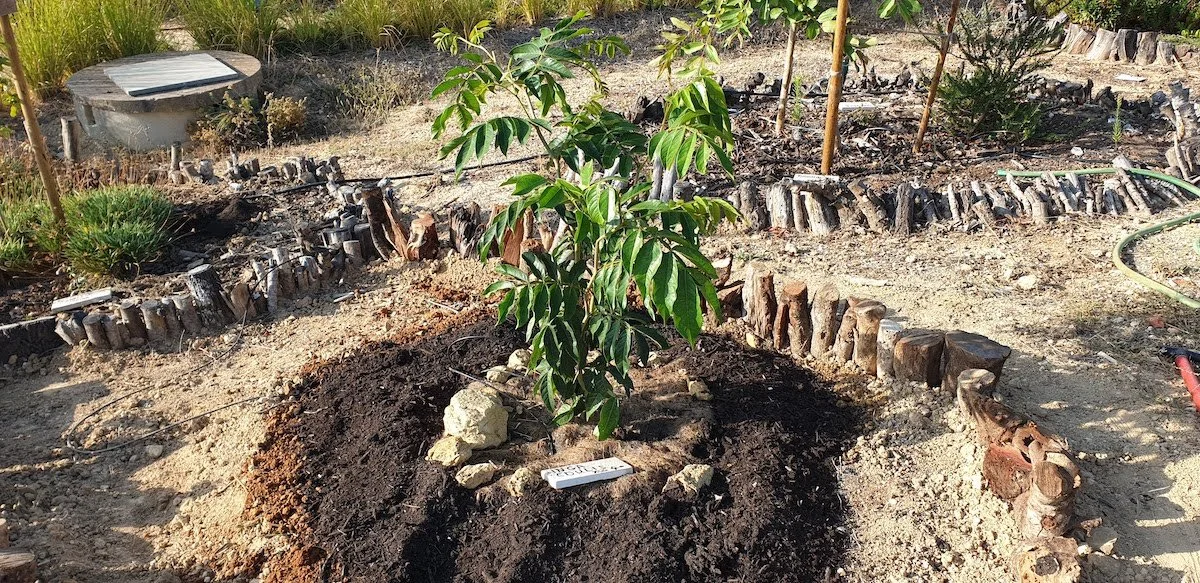
Botanical garden observation: “Trees planted as 40cm seedlings during warm months grow explosively. Under good conditions, they can reach about 3 meters within 2 years.”
Planting Steps
Choose a sunny, sheltered spot
Dig a wide hole, around 1m by 1 m
Improve drainage if needed
Do not bury the trunk collar
Water deeply and mulch well
Botanical garden observation: “In our heavy clay soil, we dig a 1 cubic meter hole and add around 200 liters of plain compost, 35 liters of well-composted horse manure, and 70 liters of acidic compost. We create a raised bed of a minimum of 35cm high.”
Fertilisation & Soil Care
Because Inga edulis fixes nitrogen through its root nodules, it has lower fertiliser needs than most fruit trees. It feeds itself and the soil around it.
Apply compost once or twice per year — ideally in spring, and optionally again in early autumn. Avoid heavy nitrogen fertilisers, which can actually reduce the tree’s natural nitrogen fixation. In Mediterranean systems, the tree’s own leaf litter is an excellent mulch: it is rich in nitrogen, decomposes slowly, and helps control weeds.
📚 For more technical details, see research on the nitrogen-fixing capacity of Inga edulis [Nichols & Carpenter, 1991] and how its leaf litter improves soil nutrients [Leblanc et al., 2000].
Pruning & Size Control
Why Prune?
Control height and spread (the canopy can become very wide)
Reduce wind damage (avoid the "sail effect")
Encourage branching, fruiting, and leaf production
Manage shade for neighbouring plants
Produce nitrogen-rich mulch from the prunings
When and How to Prune
Contrary to many other evergreen subtropical trees, Inga edulis can be pruned aggressively almost at any time of the year. It can be coppiced and re-sprouts readily even after heavy cuts.
Botanical garden observation:“At the botanical garden, Inga edulis tolerates aggressive pruning throughout the year, including coppicing. This makes it one of the most flexible trees in the collection for size management.
When coppiced, the tree will grow back more like a bushy hedge — a useful form for windbreaks or living fences. For standard tree form, regular pruning to control height and encourage branching is recommended.“
Flowering, Fruiting & Harvesting
Flowers
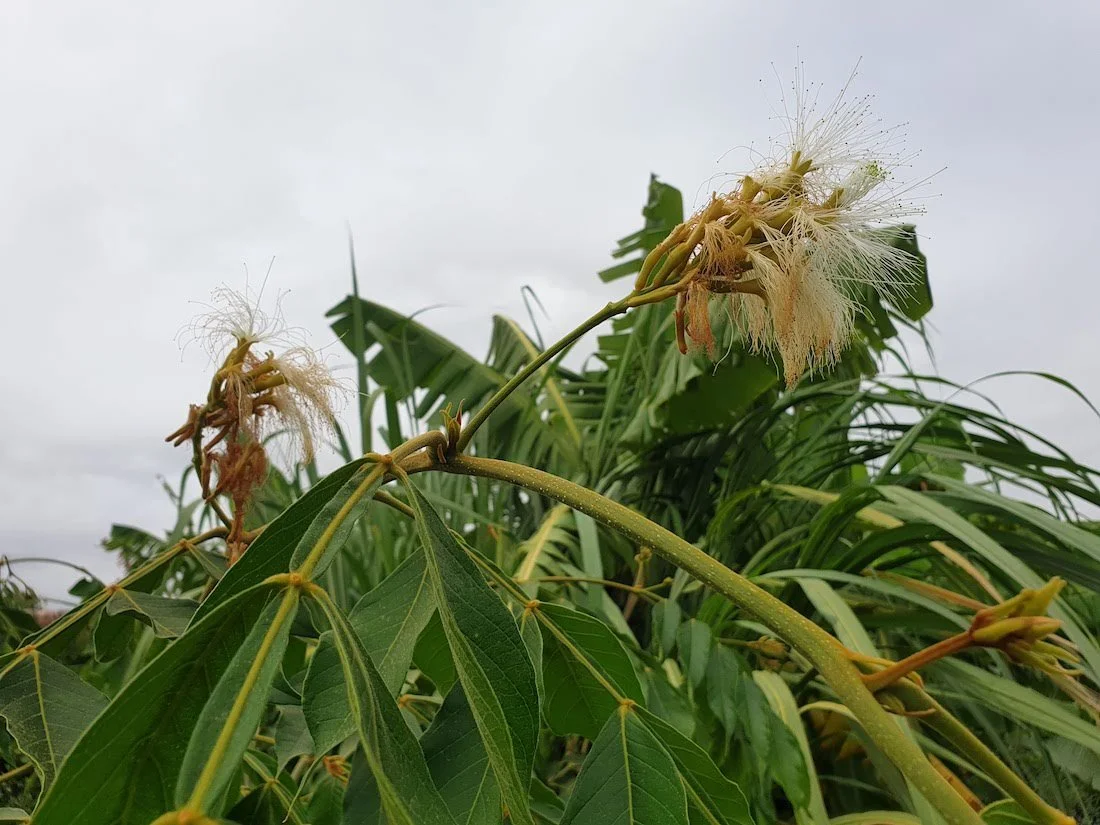
Dense clusters of fragrant white flowers with long, showy stamens. They appear near the ends of branches during warm periods and are very attractive to bees, butterflies, and other pollinators.
Fruits
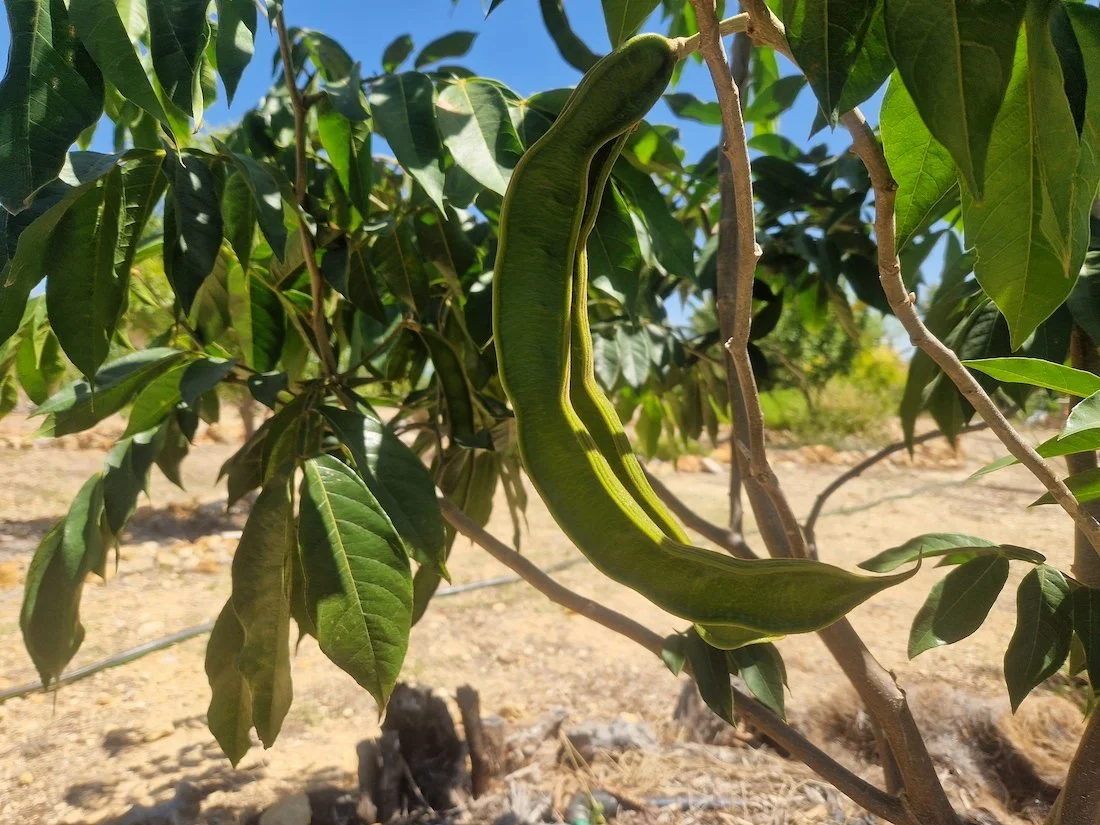
Long, cylindrical pods — sometimes straight, sometimes spirally twisted — that can reach 30cm to 1m in length depending on the variety. Each pod contains 10 to 20 seeds surrounded by sweet, white, cottony pulp.
Taste (very distinctive): The pulp tastes like vanilla ice cream, sometimes with a hint of cinnamon. The texture is soft and cottony, similar to cotton candy. This is eaten fresh, straight from the pod. The seeds of Inga edulis must never be eaten raw as they are toxic. Once boiled or roasted, however, they become edible and taste similar to chickpeas.
Harvesting
Pick pods when they feel full and slightly soft. The pulp is best eaten immediately. Shelf life is short — about 3 to 4 days at room temperature, or up to 3 weeks refrigerated.
Like Muntingia calabura, this is not a market fruit in Mediterranean climates. It is a snack tree, a conversation tree, and a tree that children remember.
Botanical garden observation: “Fruiting usually starts in the 3rd year after planting. The October–February fruiting season observed at Orchard of Flavours botanical garden in Southern Portugal makes Inga edulis a rare winter-fruiting tree in the Mediterranean context. This is a significant advantage for food forests aiming at year-round production.”
Pests & Diseases
Inga edulis is generally very resistant to pests and diseases. Few problems have been reported in cultivation outside the tropics.
Botanical garden observation: “So far, we did not observe any diseases. The pest that we have encountered are the mealy bugs. We treat these with potassium soap and paraffinic oil.”
Propagation
From Seed
Seed propagation is easy — much easier than for most tropical fruit trees. The seeds are large and germinate very quickly.
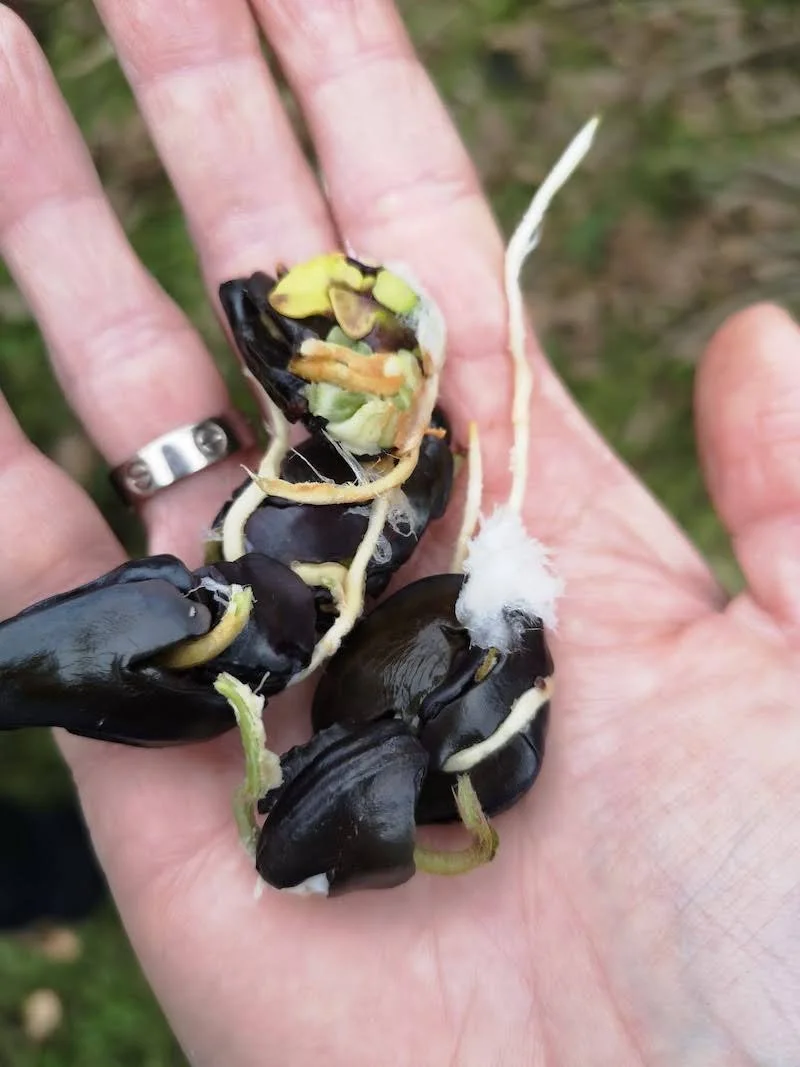
Recalcitrant seeds: they cannot be dried or stored for long. Seeds lose viability within about two weeks. Sow as soon as possible after extraction from the pod.
Seeds often germinate inside the pod before it is even picked — this is normal
Germination is fast: typically 2–5 days under warm conditions
Sow shallowly: no more than 2 cm deep in a moist, well-drained mix
High germination rate: 95–100% is common with fresh seeds
Temperature: Minimum ≥ 20 °C. Seeds germinate best in warm, humid conditions.
Early growth pattern: Seedlings can be slow during the first months, then accelerate strongly with warmth and water. In a nursery, seedlings are usually ready for planting after 5 months.
Cuttings
Less commonly used. Seed propagation is so easy and fast that cuttings are rarely necessary.
Ecological & Educational Value
In Mediterranean food forests and agroforestry systems, Inga edulis can act as:
A fast-growing shade tree, also called a "nurse tree" for younger or more sensitive plantings
A nitrogen fixer that improves the soil for neighbouring plants
A living mulch factory — its prunings produce nitrogen-rich material for ground cover
A wildlife support tree (pollinators, birds, beneficial insects)
A powerful educational and storytelling tree for visitors
Context-dependent spread: Inga edulis can naturalise in warm, humid tropical climates (it has been recorded as naturalising in parts of Australia and some Pacific islands). In Mediterranean climates, the combination of dry summers and cool winters is expected to strongly limit any spontaneous spread.
Is Inga Edulis Right for You?
A good choice if you:
Live in a warm Mediterranean or subtropical climate with mild winters
Have a protected, sunny site with access to summer irrigation
Want a tree that improves your soil while producing fruit
Are interested in agroforestry or food forest design
Want a strong visitor impact and a unique educational story
Not the best choice if: your garden regularly drops below 0 °C in winter, if your site is exposed to strong cold winds, or if you cannot provide regular water during dry summers. Inga edulis needs more water during establishment than many other subtropical trees.
📚 Scientific References & Further Reading
These peer-reviewed papers can help you verify key points (nitrogen fixation, agroforestry, seed biology, ecology, fruit composition).
1. Leblanc, H.A., McGraw, R.L., Nygren, P. et al. (2005). Neotropical legume tree Inga edulis forms N₂-fixing symbiosis with fast-growing Bradyrhizobium strains. Plant and Soil, 275, 123–133. — Supports: nitrogen fixation capacity and symbiotic bacteria.
2. Nichols, J.D. & Carpenter, F.L. (2006). Interplanting Inga edulis yields nitrogen benefits to Terminalia amazonia. Forest Ecology and Management, 233, 344–351. — Supports: nitrogen transfer to neighbouring trees in mixed plantings.
3. Lojka, B. et al. (2010). The use and integration of Inga edulis in agroforestry systems in the Amazon — a review. Agriculture Tropica et Subtropica, 43(4), 352–359. — Supports: agroforestry use, growth, pruning management, and traditional cultivation.
4. Lawrence, A. (1993). Inga edulis: a tree for acid soils in the humid tropics. NFTA 93-04, Winrock International. — Supports: soil tolerance, ecology, distribution, and nursery practice.
5. Pennington, T.D. (1997). The Genus Inga: Botany. Royal Botanic Gardens, Kew. 844 pp. — A comprehensive botanical monograph covering morphology, ecology, distribution, chemistry, and species descriptions for 258 species of Inga.
Come down for a visit of the Orchard of Flavours, in Tavira, Algarve, and see our ice-cream bean trees! 🍦
This article was written by Miguel COTTON — founder of Orchard of Flavours Botanical Garden, in Tavira, Portugal. If you have any questions or suggestions, do not hesitate to contact us: miguel@orchardofflavours.com