
Food trees you can grow down to −18 °C
Yes, you can grow food trees where winters are cold. Our botanical garden in southern Portugal grows 60+ food plants, from 42 species, that are rated to survive winter nights of about −18 °C (USDA hardiness zone 7).
This page lists them all.
In a hurry?
See all 60+ plants with photos
Download the list (PDF)
Is this your climate?
This list is for gardens where the coldest night of the year is around −18 °C. Think Berlin or Prague.
If your winters are milder, you can grow everything on this page and more. See our lists for −12 °C, −7 °C and −1 °C.
Seven plants worth knowing
Che (Maclura tricuspidata)
The fruit looks like a large raspberry. People taste fig, mulberry or melon in it. It must be fully ripe: before that, it is bland. In the Algarve it is one of the toughest fruit trees we know.Japanese raisin tree (Hovenia dulcis)
The part you eat is not the fruit. It is the swollen, twisted flower stalk, which becomes juicy and sweet when ripe. It tastes of raisin, fig and pear.Nashi (Pyrus pyrifolia)
A pear that crunches like an apple: round, juicy and crisp even when fully ripe. It is best eaten cold, straight from the tree. We grow ‘Hosui’, ‘Nijisseiki’ and ‘Shinseiki’.Nanking cherry (Prunus tomentosa)
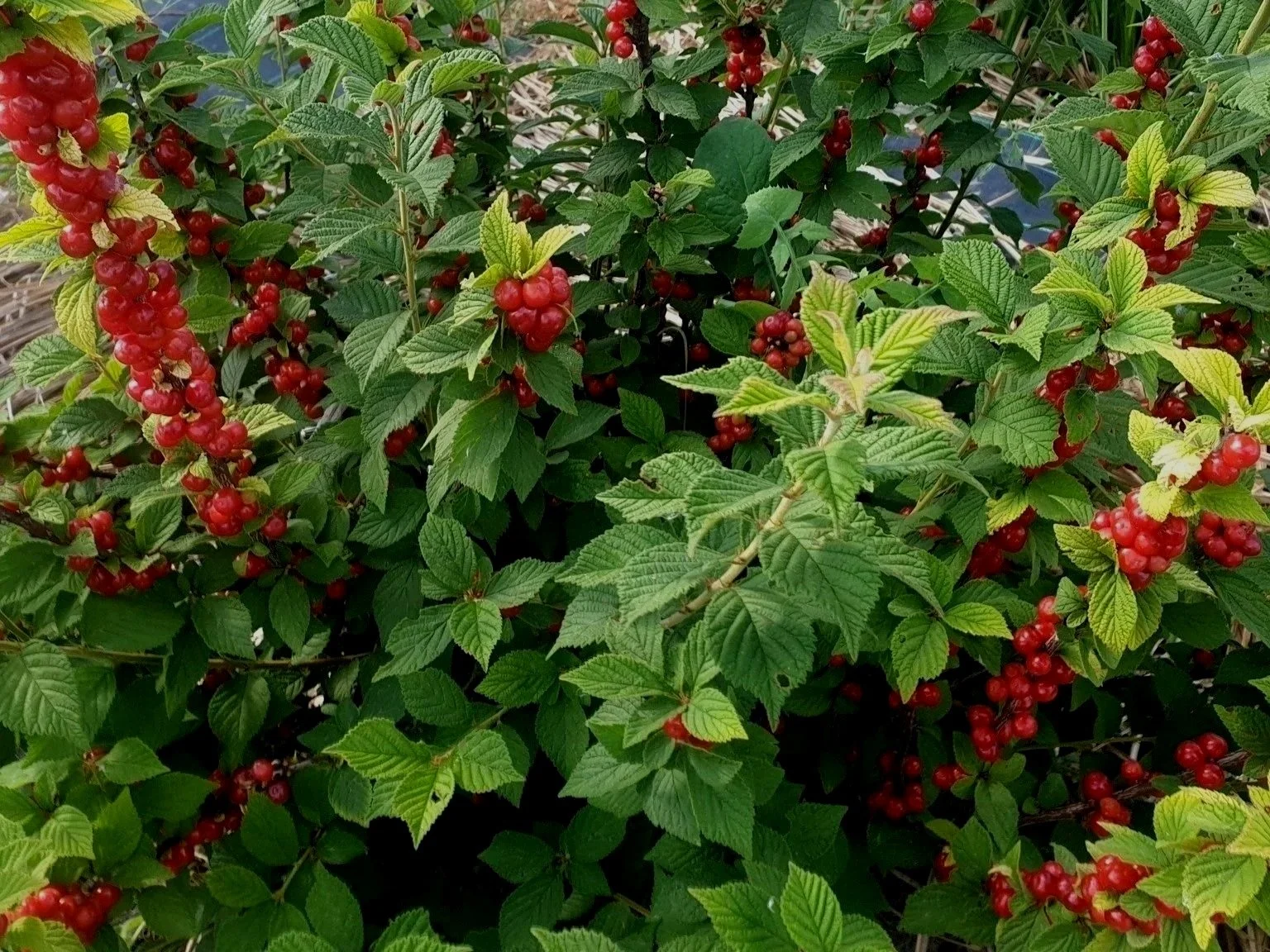
A shrub of 2 to 4 metres with small red fruits, sweet and sharp like red currants. Eat them by the handful, or make juice, jam or wine.Medlar (Mespilus germanica)
The fruit is eaten only after it has softened, a process called bletting. The flesh then turns into a sweet paste that tastes like spiced apple sauce. The brown, wrinkled skin looks spoiled, but the inside is good.Sichuan pepper (Zanthoxylum simulans)
The spice is the dried husk of the berry, not the seed. It has a citrus flavour and makes the lips and tongue tingle. It belongs to the citrus family and is not related to black pepper. Five species of Zanthoxylum are on this list.Sea buckthorn (Hippophae rhamnoides)
The berries are too acid for most people when raw. They are mostly used for juice, which is high in vitamins, and they become less acid after a frost. You need a male and a female plant to get fruit.
To be honest. Surviving winter is not the same as ripening fruit. Pecan needs a long, hot summer. Apricot flowers early and can lose its crop to a late frost.
The ratings on this page come from published sources, not from our own trials: our winters are too mild to test them. A cultivar can be more or less hardy than its species. Before you buy, ask a nursery near you.
See every plant, with photos
The full list: 60+ plants, 42 species that grow at -18 ºC
-
Apple (Malus domestica): 'Almata', 'Anna'
Apricot (Prunus armeniaca): 'Beliana', 'Bulida', 'Canino', 'Ninfa'
Bamboo (Phyllostachys bissetii)
Bamboo (Phyllostachys viridis)
Banana yucca (Yucca baccata)
Beef and onion plant (Toona sinensis)
Black mulberry (Morus nigra): 'Wellington'
Blue sausage fruit (Decaisnea fargesii)
Boy's love (Artemisia abrotanum)
Che (Maclura tricuspidata): 'Che seedless', 'Darrow', 'Norris Seedless'
Common sage (Salvia officinalis)
Goji (Lycium barbarum)
Greek Origano (Origanum vulgare): 'Hirtum'
Japanese dogwood (Cornus kousa): 'Nicole'
Japanese mulberry (Morus bombycis): 'Shin-tso'
Japanese raisin tree (Hovenia dulcis)
Japanese silverberry (Elaeagnus umbellata): 'Sweet and sour', 'Sweet scarlet'
Japanese walnut (Juglans ailantifolia): 'Cordiformis'
Medlar (Mespilus germanica)
Mojoberry (Morus rotundiloba): 'Matsunaga'
Mountain pepper (Tasmannia lanceolata): 'Female', 'Male'
Mulberry (Morus × hybrida): 'Red N° 2'
Nanking cherry (Prunus tomentosa): 'Snovit'
Nashi (Pyrus pyrifolia): 'Hosui', 'Nijisseiki', 'Shinseiki'
Nepalese pepper (Zanthoxylum armatum)
Nude sheath bamboo (Phyllostachys nuda)
Oriental silverberry (Eleagnus angustifolia): var. orientalis
Pear (Pyrus communis): 'Cocomerina', × Pyrus pyrifolia 'New World'
Pecan tree (Carya illinoinensis): 'Mahan' (group B), 'Pawnee' (group A), 'Syrup mill' (group A)
Purple chokeberry (Aronia × prunifolia): 'Nero'
Quince (Cydonia oblonga): 'Gamboa'
Sea buckthorn (Hippophae rhamnoides): 'Ascola' (female), 'Frugana' (female), 'Polmix' (male)
Sichuan pepper (Zanthoxylum giraldii)
Sichuan pepper (Zanthoxylum piperitum)
Sichuan pepper (Zanthoxylum simulans)
Small-leaved linden (Tilia cordata)
Tortoise-shell bamboo (Phyllostachys edulis)
Trifoliate orange (Citrus trifoliata)
True Chinese Sichuan pepper (hua jiao) (Zanthoxylum bungeanum)
Violet bamboo (Phyllostachys praecox)
White mulberry (Morus alba): 'Emmanuelle', 'Gerardi dwarf', 'Giant fruit', 'Golden Louis', 'milanowek'
Yellowhorn (Xanthoceras sorbifolium)
Questions people ask
What does ‘USDA zone 7’ mean?
A hardiness zone describes the coldest night of an average winter. In zone 7 that night is between about −18 °C and −12 °C. A plant rated for zone 7 is expected to survive it.
Do I need more than one plant to get fruit?
For some, yes. Sea buckthorn has male and female plants, so you need one of each. Nashi gives more fruit with a second variety nearby. In our records, che, medlar, Nanking cherry and the Japanese raisin tree are self-fertile: one plant is enough.
Why does a garden in Portugal grow trees for cold winters?
Because many food trees are comfortable with both. Che, nashi, Sichuan pepper and the Japanese raisin tree come from East Asia, where winters are cold and summers are hot. They accept our heat and your frost.
Take the list with you
Not your climate? Food trees for −12 °C · −7 °C · −1 °C